
A flurry of papers
/We have published several papers in the past few months, including some exciting blue astrocomb results; a novel spectrograph calibration method; and a low-repetition rate OPO based incorporating a Herriott cell. See the Publications tab for more details!


New paper on GPU-accelerated modelling of dispersive OPOs using the nonlinear envelope equation
/We have published a new paper in which we model highly dispersive OPOs using a nonlinear envelope equation, employing a GPU to achieve >1000x faster results compared to a high-end CPU. We can now explore systems with long nonlinear crystals, previously unachievable due to long execution times.

New paper on a synchronously-pumped OPO cavity formed from Brewster mirror prisms
/We have published a new paper in which we report the design and operation of a novel OPO cavity formed from high refractive index inverted prisms, also known as Brewster mirrors. The prisms provide sub-nm/mm signal wavelength tuning, producing a highly stable cavity that attractive for frequency comb applications.

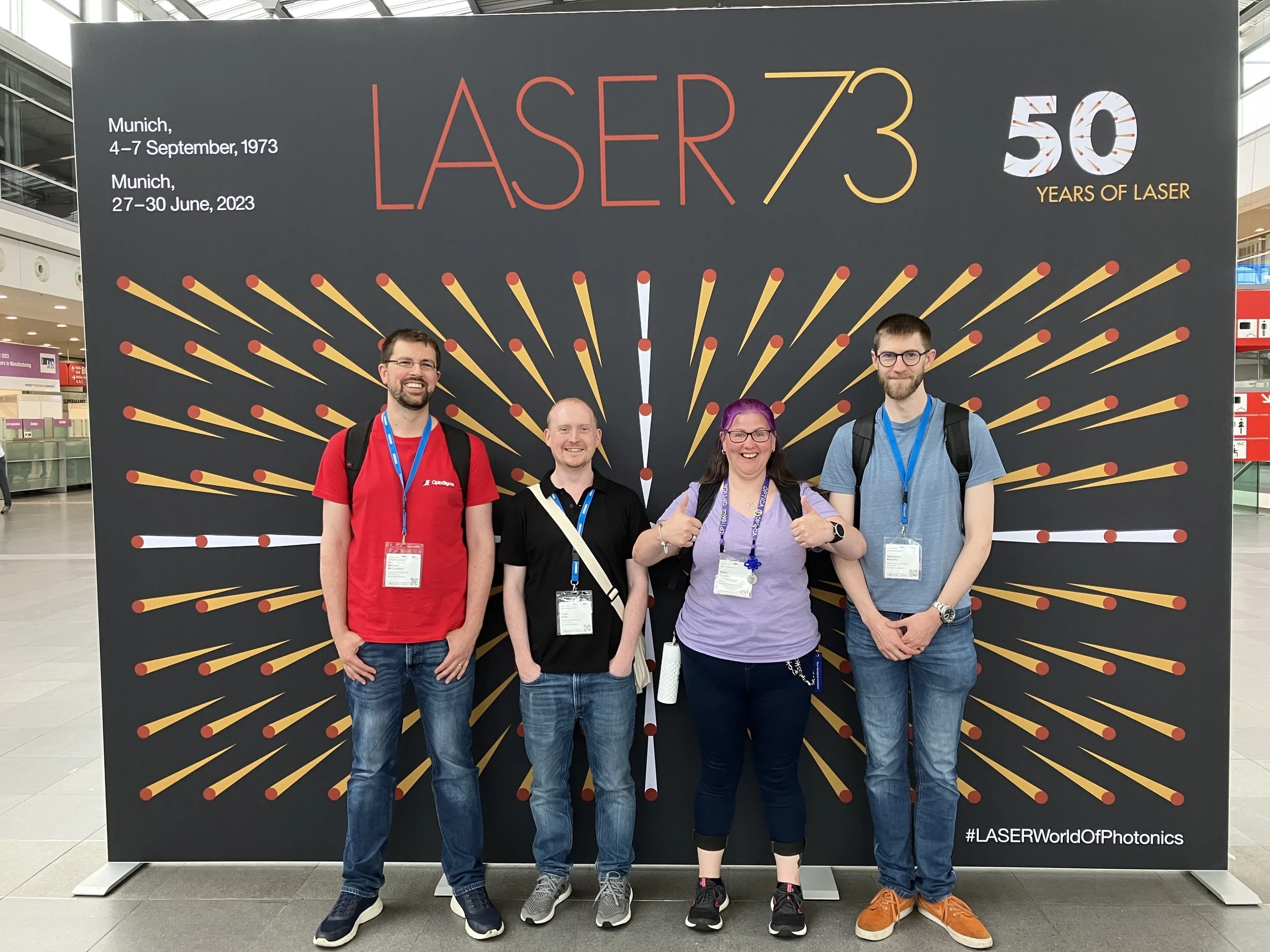
The group visits CLEO Europe and Laser Munich
/We had a great visit to CLEO Europe and Laser Munich last week! Danny, Ewan and Seb all presented their work and had great engagement from the attendees. Well done to all!


A belated welcome to Seb and farewell to David
/Life events took priority in the latter part of 2022, so I failed to post some important news in a timely manner - apologies!
Firstly, a warm welcome to Sebastian Robarts who joined the group in October as a PhD student. Seb graduated from Heriot-Watt University in 2022 with a BSc in Mathematical Physics. His undergraduate project built upon work completed as part of a Carnegie vacation scholarship, in parallelised full-field modelling of OPO cavities, expanding applications of the model to highly dispersive systems and birefringent phase matching. During his PhD he will be working to further enhance computational modelling of devices for ultrafast photonics and quantum optics, with a view to optimising the design process for systems producing bespoke spectra.
Second, we bid farewell to Dr David Bajek who has left Heriot-Watt University to join the University of Strathclyde as a Senior Research Fellow at SCAPA, the Scottish Centre for the Application of Plasma-based Accelerators. We wish David all the best in his future career!
Students attend their first in-person conference in 2 years!
/
PhD students Danny Hunter and Ewan Allan are both in Nottingham this week to present their work at Photon2022. This is the UK’s largest national photonics conference and is a great opportunity for PhD students and PDRAs to network and discuss their research. As both students enter their third year of studies, they are taking this time to relax as well as work!


New paper on Kerr-lens mode-locked hot-isostatic-pressed Cr:ZnSe laser
/We have published a new paper comparing the performance of a Kerr-lens mode-locked Cr:ZnSe laser before and after hot-isostatic-pressing (HIP) of the laser medium. HIP-treating the crystal produces shorter pulses and more stable mode-locking. Congratulations to our colleagues in Milan for this great result!

New paper on modelling single laser asynchronous optical sampling (SLASOPS)
/Today we have published a new paper discussing the theory behind SLASOPS (single laser asynchronous optical sampling), a single-laser alternative to the conventional two-laser ASOPS technique. Congratulations to Dr David Bajek who has driven this research, and to undergraduate Ife Ejidike who carried out much of the modelling. We thank the STFC for funding to make this research possible.

Teambuilding!
/Our first group teambuilding event was held earlier this month, where we scoured the streets of Edinburgh for clues to stop Operation Mindfall! A big thanks to Escape Hunt for hosting us!

New publication on an ultrafast OPO incorporating Pellin-Broca prisms
/We have a new paper published in Optics Express written by PhD student Danny Hunter. The paper, titled Ultrashort-pulsed optical parametric oscillator employing Brewster angle prism retroreflectors, uses a pair of BK7 Pellin-Broca prisms in place of cavity mirrors to produce a compact cavity that displays reduced sensitivity to misalignment.
The OPO produces chirped signal pulses which are tuneable across 1100-1350nm, and which are externally compressible to sub-150-fs durations. Power scaling is limited by crystal damage, so we will be exploring PPLT as an alternative and will also investigate CaF prisms. Well done Danny!

New publication on modelling fiber-feedback OPOs
/We have a new paper published in Optics and written by PhD student Ewan Allan and undergraduates Craig Ballantine and Seb Robarts. The paper, titled Modelling dispersion compensation in a cascaded-fiber-feedback optical parametric oscillator, investigates the use of cascaded SMF-28 and UHNA fibers to balance dispersion in an OPO incorporating single-mode fiber as a length-eating mechanism.
This publication is exciting for two reasons: first, it is the inaugural publication from the McCracken Lab based on our STFC-funded project Harnessing photonic technologies for deep-tissue imaging, and second, it is the result of hard-working undergraduates who joined us for summer and dissertation projects - a great achievement!

Heriot-Watt University has joined with the UK Astronomy Technology Centre (UKATC) to make Edinburgh a world centre for astrophotonics
/Astrophotonics is the field that aims to harness advances in photonics, the optical equivalent of electronics, to give astronomical instruments unprecedented capabilities.
Heriot-Watt is leading a new consortium, which includes partners from the UKATC, the University of Arizona and the Max Planck Institute for Astronomy in Heidelberg.
The project has received over £890,000 in funding from the UKRI Science and Technology Facilities Council to pursue two main areas of research.
Professor Robert Thomson, head of Heriot-Watt’s Photonic Instrumentation Group said: “We find ourselves at a point where conventional approaches to optical instruments like telescopes are reaching their limits.
“Astrophotonic technologies offer a route to circumvent these limits and help astronomers discover more about our universe.”
Thomson’s group will focus on developing new optical components.
“Our aim is to use advanced photonic manufacturing techniques to fabricate optics that are not limited in their shape like normal optics. In the long term, this will allow astronomical instruments that are more efficient and lower cost.”
Professor Derryck Reid, head of the Ultrafast Optics Group at Heriot-Watt, will focus on improving the way astronomers measure light.
“We’re going to demonstrate a new class of small, ultra-stable lasers that will provide a ‘ruler’ for the wavelength of light. This will allow astronomers to measure the wavelength of starlight extremely precisely, and in a way that allows comparisons over years and even decades.
“The wavelength signatures of starlight can reveal exciting information about questions such as whether life exists on exoplanets, or if the fundamental constants of physics are in fact changing by tiny amounts.”
Professor Chris Evans, head of science at the UKATC, said: “As we build larger telescopes to look deeper into the universe, they scale upwards in size and cost with traditional optics.
"Establishing this joint project with Heriot-Watt gives us an exciting opportunity to explore the huge potential of new photonic technologies towards the cutting-edge astronomical instruments of the 2030s and beyond.”
The three-year project aims to demonstrate new research and builds on sustained funding to Heriot-Watt from the STFC and other funding organisations such as the EU over the past decade. It will also support work that is taking astrophotonic technology to the higher technology readiness levels needed for deployment on major international projects like the Extremely Large Telescope.
New publication on an astrocomb for the Extremely Large Telescope
/We have a new paper in JOSA B written in collaboration with Yuk Shan Cheng, Dong Xiao and Derryck Reid (Ultrafast Optics Group, Heriot-Watt). The paper, titled Laser-frequency-comb calibration for the Extremely Large Telescope: an OPO-based infrared astrocomb covering the H and J bands, describes a broadband astrocomb spanning 1.15 - 1.80 microns, and a technique to characterise the comb using a Fourier-transform spectrometer. Congratulations to Shan on these results!

New paper published on stabilisation of degenerate femtosecond OPOs
/It’s a bumper week, as we have also published a new paper in Optics Letters, written in collaboration with Yuk Shan Cheng and Derryck Reid (Ultrafast Optics Group, Heriot-Watt). The paper, titled Dither-free stabilization of a femtosecond doubly resonant OPO using parasitic sum-frequency mixing, describes a low-noise method of DRO locking, and is Shan’s first publication - congratulations!

New paper published on configurable materials for single-photon generation
/We have published a new paper in Advanced Quantum Technologies, written in collaboration with Dmytro Kundys, Bodan Kundys, Francesco Graffitti and Dr. Alessandro Fedrizzi (http://www.mostlyquantum.org/). The paper, titled Numerical Study of Reconfigurable Mid-IR Single Photon Sources Based on Functional Ferroelectrics, describes a method of generating mid-infrared single photons using novel functional materials that can be dynamically re-poled using relatively low electric field strengths.

Welcome to MPhys project student Lewis Williamson!
/Lewis Williamson has returned to Heriot-Watt to complete his MPhys degree. His research project will focus on the development of novel OPO geometries for versatile wavelength tuning.

Welcome to summer student Danny Hunter!
/Danny Hunter is joining the lab for six weeks while she carries out a summer project. Danny will be developing novel OPO geometries for versatile wavelength tuning, and is supported by an IPaQS studentship.

We are recruiting!
/We have an opening for a Postdoctoral Researcher working on high-energy OPOs for three-photon microscopy. The position is for 3 years, and the successful candidate will develop compact, low-rep-rate OPO cavities to produce sub-µJ pulses in the near-infrared. This project is funded by the STFC and will be carried out with industrial collaborators Chromacity and Scientifica. You can email r.a.mccracken@hw.ac.uk directly for more information.
The lab refurb is complete!
/It’s taken a while, but the lab refurbishment is now complete. Heriot-Watt Estates have installed a new ceiling and floor, have painted the walls, and have added storage and shelving. The School of Engineering and Physical Sciences have purchased a new optical table and have generously paid for the refurbishment works, so a big thank you to everyone who made this possible.

